The method
I help the sound of your voice match the expertise in your head.
We coordinate the voice so that your voice has more options, more colors that you can use to paint. Then we figure out the other stuff. With what intention are you showing up? What’s the mindset? What’s at stake for you personally?
The Seven Skills of Tonality
Monotone is a failure to lead your listeners’ attention.
It is not how much you can vocally dance.
This follows a curriculum. What I teach is the seven skills of tonality. It’s my own IP, and it’s what we work on during every session. I always start in order, especially with the first one. Skills one and two are literally how we speak, how we make sounds. Skills three through seven are pretty squishy and intangible, and intention, I think, is the biggest linchpin in there.
Resonance
We conflate pitch with the quality of depth. Depth is a quality that comes from resonance. Resonance is when two things with a sympathetic vibration meet, and that sympathetic vibration creates something new. Your voice can become more than it already is without you having to do any affectations, like lowering it.
Articulation
Literal articulation is the coordination by which we make the sounds that form words. Tone is just the absence of noise in every syllable. Figurative articulation is how concisely you make your point.
Imagination
Being aware of and then mapping to yourself what you experience, so that you can recreate it, so that you can identify when it’s not there, and so that you can get it back when you want it.
Mindset
Our mindset is the transcription of the dialog that’s running in your brain. It’s largely a story. That’s going to change how you speak and how you sound, but it’s also going to change your level of conviction to lead people.
Intention
Micro: what’s the specific action that we want somebody to take? It’s not “I want them to be happy.” I want them to raise their hand. Macro: I am only speaking so that I can help you win.
Subtext
It’s not an emotion, it’s an action. Are you pleading, are you scolding, are you inviting? Subtext is the consistent undercurrent, what’s embedded in the words without actually explicitly being in there.
Stakes
What happens if that action is not taken, for them, for you, for everybody? You see somebody across the street, and they are about to get hit by a bus. If they take one more step, what do you say?
The Message and The Mission
Communicating a message is not saying 10,000 things one time. It’s saying one thing 10,000 different ways.
The message and the mission is one of my favorite things to teach. Anytime I go on a podcast, or just talk to somebody, it doesn’t matter where we are, I’ve got this whole philosophy that I can tie the conversation back to.
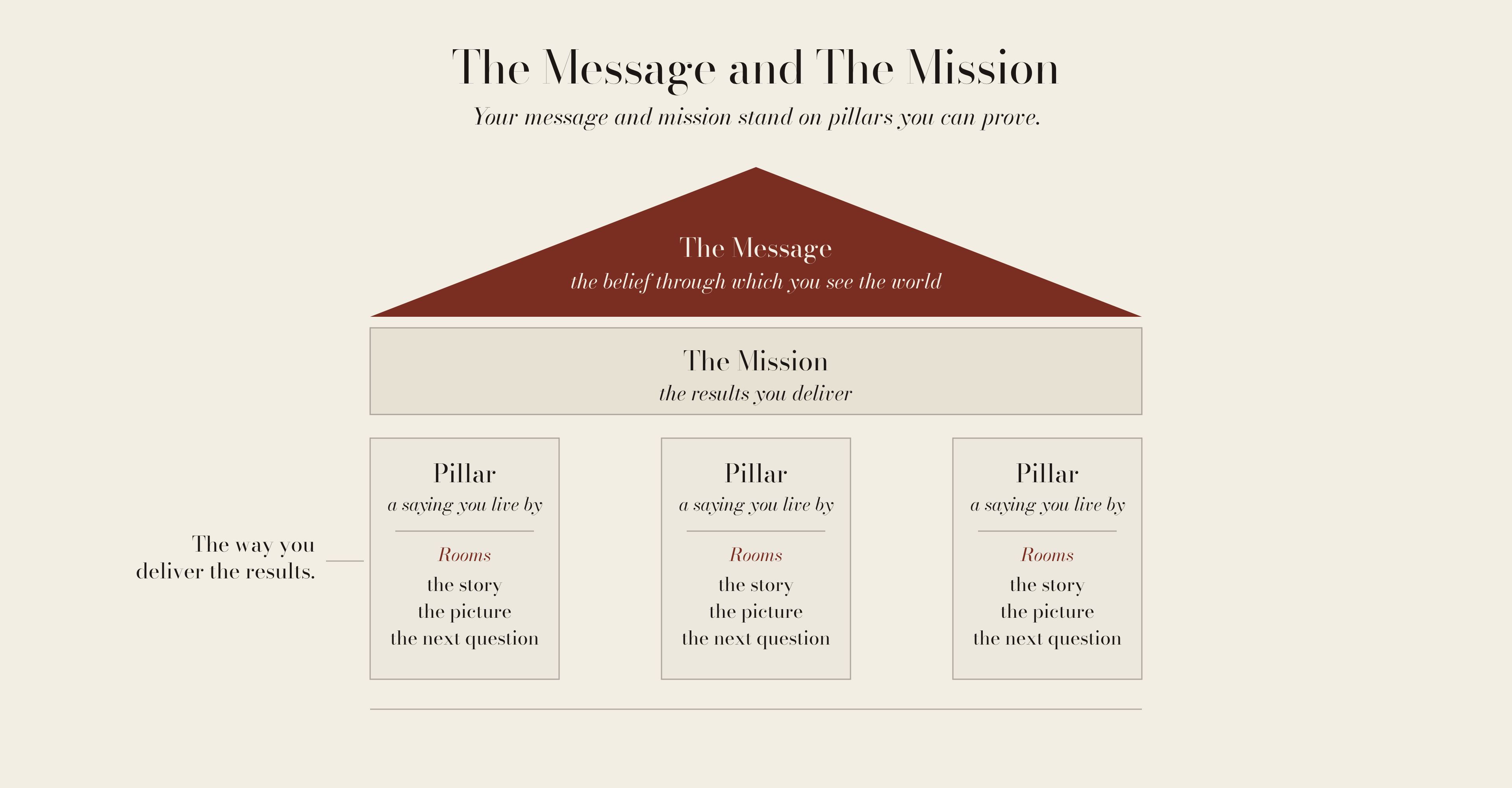
Mine
- The message
- Your voice tells the world who you are.
- The mission
- Helping people reclaim the agency they’ve lost, so they can go do what they were built for.
- The pillars
Intention. Speak so that others will win, not so that you’re validated. Be of service or be of self.
Creativity. Create from a state of play. Creativity is an invitation to connect.
The body. Your body is your business card.
Yours
- If we interviewed your employees, co-founders, partners, and family, what would be the common themes?
- What do you recognize of yourself in those themes?
- And so what? What did those things do for you?
- What kind of people are you helping? Who’s the little guy, against who?
- When did you feel that way in your life?
- Keep on drilling down. Simplify that even more.
- Put these ideas into your subconscious. Have your notes app handy, or just a pen and paper.
Engagements
Get your identity to catch up to your resume.
Close the gap between what you know and how you sound.
Work one-on-one with Michael through the rooms that matter: the raise, the promotion, board meetings, investor calls, podcast and panel appearances, the speaking circuit, and internal conversations.
Engagements are offered selectively. For a team or a firm, mention it when you schedule.
Schedule a consultation- Sessions
- Consider me on retainer, not hourly. An hour a week minimum.
- Between sessions
- Every interview, panel, podcast, and pitch reviewed
- High-stakes rooms
- Prepped, rehearsed live, and debriefed
- Where
- Zoom or in person